
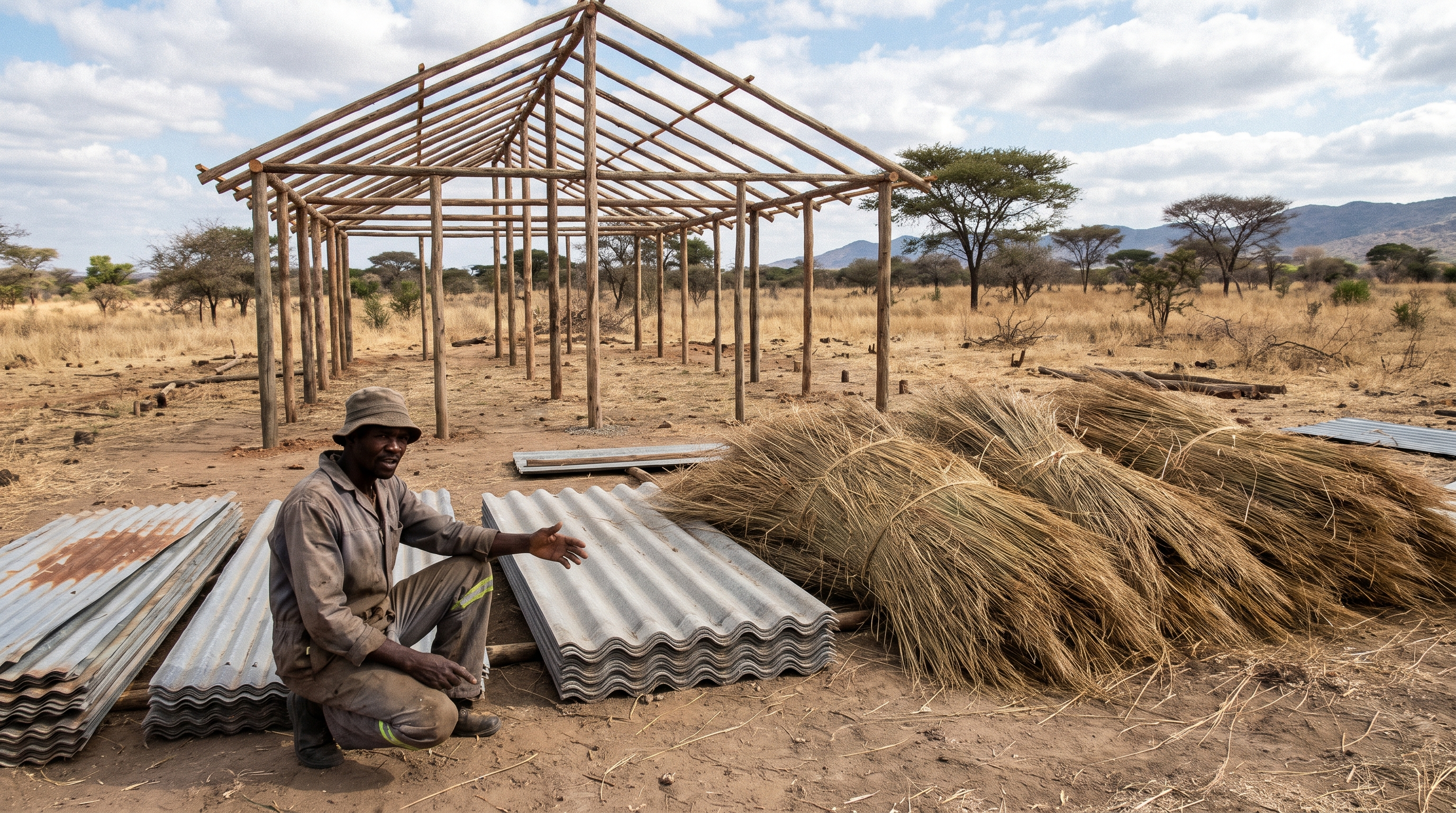
Farmers pricing a new barn, sty or fowl run in Zimbabwe usually compare roofing on one number — cost per sheet — and that number alone points toward fibre-cement (asbestos-type) sheeting almost every time. It's the wrong comparison. The frame underneath the roof, the pitch you build it at, and how much heat it lets into the structure below all move the real cost, and they move differently depending on which material you pick.
What the sheets themselves cost right now
At current pricing from Zimbabwe Building Materials Suppliers, galvanized IBR sheeting starts around US$3.45 for 0.25–0.30mm gauge and climbs to about US$5.00 at 0.40mm and US$7.50 at 0.6mm — thickness buys you dent resistance and a longer service life before the galvanising fails. A full 3.6m (12ft) length IBR sheet lists at roughly US$9.00. Fibre-cement sheeting, still sold widely under the Turnall brand through outlets like Halsteds, looks cheaper at first glance for a given coverage: a 3.6m by 920mm sheet runs about US$27.50, but it covers a wider span per sheet than a single IBR profile and needs fewer overlaps, which narrows the real per-square-metre gap between the two materials.
The gap that doesn't narrow is weight. Fibre-cement sheeting is dramatically heavier than galvanized steel, and that weight has to go somewhere — into a stronger, more closely-spaced pole or truss frame. Treated gum poles for that frame are priced by diameter and length at ZBMS: small 25–50mm poles run from about US$0.50 for a 0.5m length up to roughly US$1.38 at 1.5m, while the 100–125mm poles needed to carry a heavier roof cost US$4.13 to US$4.68 over 1.2–1.5m lengths, and 150–200mm poles run US$9.63–US$11.00 over the same lengths. A structure roofed in fibre-cement typically needs the heavier end of that range and closer purlin spacing than the same building roofed in IBR — so the saving on sheet price is partly, sometimes entirely, spent back on the frame.
Pitch and heat: the part that's easy to skip
FAO's guidance on tropical farm structures and poultry housing design points to a roof pitch of around 42° as a practical compromise between material use and the cost of the supporting structure, steep enough to shed heavy seasonal rain fast and to encourage the hot air trapped near the ridge to keep moving rather than sitting still. A pitch built too shallow to save on pole length or sheet count holds heat under the roof and struggles to clear water fast enough in a heavy Zimbabwean thunderstorm — a false economy on both counts.
Colour and reflectivity matter almost as much as the material itself. FAO's small-scale poultry guidance notes that white paint reflects up to roughly 70% of incident solar heat radiation compared with an unpainted or dark sheet, which is a meaningful, low-cost intervention on any livestock structure — a coat of light-coloured paint on new IBR sheeting, or on the exposed underside of a fibre-cement roof, cuts radiant heat load into the space below for a fraction of what re-roofing would cost.
Where thatch still makes sense
Thatch remains the best insulator of the three where the grass and the skilled labour to lay it are locally available — it holds a cooler interior through the hottest part of the day than either sheet material, which is valuable for structures like farrowing pens or brooder houses where heat stress is a direct welfare and mortality risk. Published thatching rates are mostly South African (commonly quoted around R450–R750, roughly US$28–US$47, per square metre supplied and fixed), and Zimbabwe-specific published rates are scarce, so treat that as a rough proxy rather than a local quote — get pricing from a local thatcher before budgeting against it. Thatch also carries a fire risk and a shorter maintenance cycle than either sheet option, which is why most commercial-scale Zimbabwean builds default to IBR or fibre-cement and reserve thatch for smaller structures or where cost of sheeting and transport to a remote site is prohibitive.
The practical comparison
For a small backyard structure, fibre-cement's lower per-sheet cost and wider coverage can still win even after accounting for a slightly heavier frame. For anything spanning a wide building — the kind of pigsty or barn that needs a properly engineered truss — the lighter weight of galvanized IBR usually offsets its higher per-sheet price through cheaper poles and simpler trusses. Price both options as a system — sheeting plus frame plus paint — not as a per-sheet comparison, and the right choice usually becomes obvious.
Sources
- IBR Roofing Sheets Prices, Galvanized and Asbestos Sheets Prices and Treated Poles Prices, Zimbabwe Building Materials Suppliers
- Farm Structures in Tropical Climates, FAO — animal housing design manual
- Small-scale poultry production, FAO
- Thatch Roof Prices in South Africa: 2026 Cost Guide, Master Thatching