
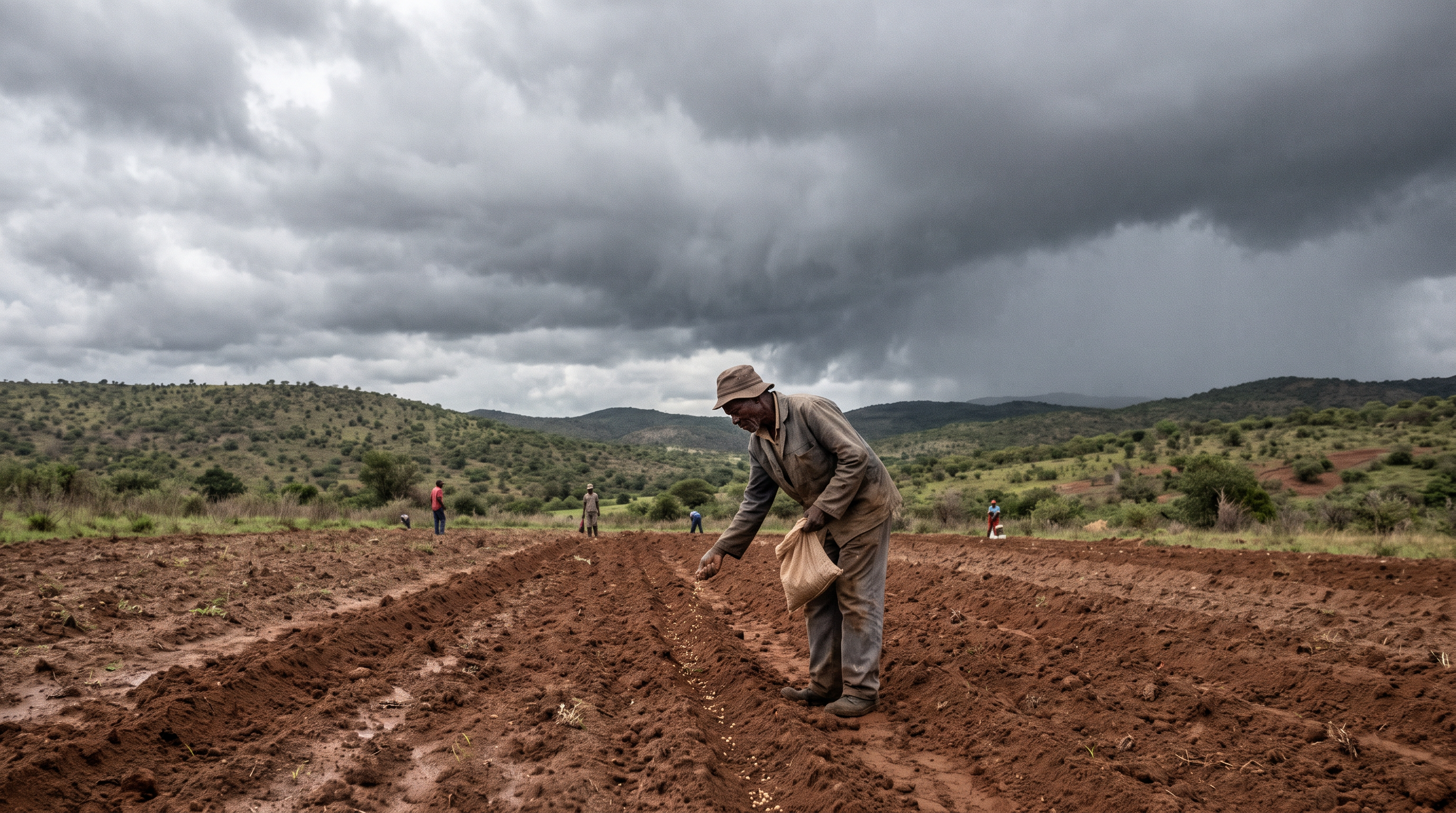
Most Zimbabwean farmers plant maize on instinct and habit — when the rains "feel" ready, or whenever neighbours start. A detailed study of Hwedza district put a number on what that habit costs in yield.
What the Hwedza data found
Researchers combined a survey of 438 smallholders, 49 years of historical rainfall records (1949–2012) and DSSAT crop-simulation modelling for Hwedza district (altitude 1,425 m, average annual rainfall 807 mm) to test three planting-date criteria against actual yield outcomes. The results pointed to the second dekad of November — 11–16 November — as the optimum planting window. Yet only a minority of surveyed farmers planted that early; 31.4% said they preferred the third dekad of November instead, planting later than the data supports.
The yield difference by variety and criterion was substantial. Medium-season varieties (56–65 days to flowering) combined with the AREX planting criterion — more than 25 mm of rain in 7 days with no 10-day dry spell in the following 20 — produced the district's highest average yield, at 0.9 t/ha. Medium-season varieties overall averaged 0.925 t/ha against 0.750 t/ha for short-season varieties and just 0.479 t/ha for long-season varieties. Statistically, medium and short-season varieties performed similarly, so either is a reasonable choice, but long-season varieties consistently underperformed and carry more drought risk in a district receiving only 807 mm of rain a year on average.
The single strongest yield driver in the model wasn't total rainfall — it was the number of rain days (p = 0.0049), meaning distribution matters more than volume. That lines up with the study's dry-spell finding: droughts lasting more than 14 days have a 15-17% chance of hitting during the January-February window, right as maize reaches silking — the crop's single most sensitive stage, where water stress can wipe out most of the yield. Moisture stress earlier in the season, at the 8-16 leaf stage, is less severe but still costly, cutting potential yield by 10-50%.
Reading the calendar against Zimbabwe's regions and a bad season
Hwedza sits near the boundary of what FAO classifies as Natural Region II and III (roughly 500–1,050 mm of annual rainfall), so its 11–16 November window won't transfer directly to drier Region IV and V areas, where planting decisions lean more heavily on waiting for a confirmed rain event before committing seed, or to the wetter Region I areas above 1,050 mm where the growing season starts and runs longer. The AREX and MET planting criteria the study tested were designed to be reusable across districts precisely because rainfall timing, not the calendar date itself, is what should trigger planting.
The 2023/24 season is the clearest recent argument for planting on data rather than habit. Zimbabwe's El Niño-linked drought that year saw more than 80% of the country receive below-normal rainfall, a state of disaster declared in April 2024, and roughly a million hectares of maize written off nationally — a season in which farmers who delayed planting while waiting for more rain, or who stuck with long-season varieties, had far less room to recover from the dry spells that followed. The lesson from both the Hwedza data and that season points the same way: plant medium-season varieties as soon as a recognised rainfall criterion is met, rather than defaulting to late November because that's when the neighbours start.