
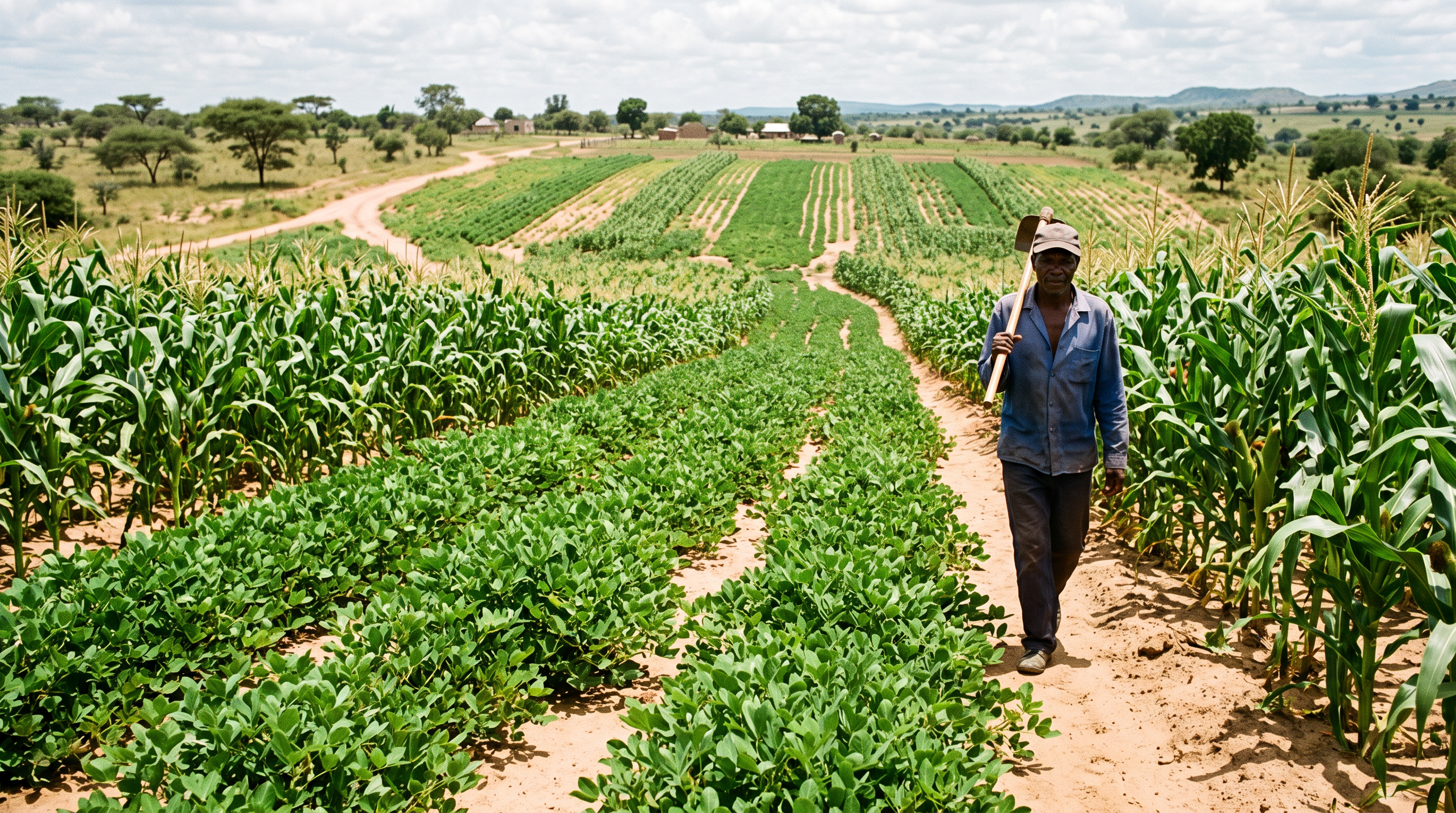
About two-thirds of Zimbabwe's arable land sits on granite-derived sandy soils that are naturally low in organic carbon, nitrogen, phosphorus and sulphur — soils that mine nutrients fast under continuous maize and give little back without heavy fertiliser input. Rotating maize with groundnut, a nitrogen-fixing legume, has been researched in Zimbabwe for decades specifically as a way to keep these soils productive without relying entirely on purchased fertiliser.
What the rotation trials show
The clearest long-term data comes from on-station and smallholder trials led by Waddington and Karigwindi across sub-humid Zimbabwe. On-station, where groundnut yields ran 0.26–0.355 t/ha of shelled grain, rotating with unfertilised maize nearly doubled the following maize crop — from 2.46 t/ha under continuous, unfertilised maize up to 4.61 t/ha after groundnut. Where fertiliser was also applied to the maize, the rotation contributed a further 2.93 t/ha on top of that.
The catch is how much smaller that gain looks once you leave the research station. The trial ran for six years across six smallholder sites in northeast Zimbabwe. On the farms growing continuous maize without purchased fertiliser, yields sat in the 0.5–0.8 t/ha range over five of those years, and at five of the six sites the groundnut rotation lifted maize yield by only about 0.28 t/ha on average — a real but modest gain, not the near-doubling seen on-station. Where fertiliser was applied to maize as well, the rotation only showed a measurable benefit at two of those five sites. The study's own conclusion was blunt: once labour costs for growing groundnut are counted, the rotation's profitability compared with continuous fertilised maize is marginal — part of why researchers observed farmers quietly cutting back on groundnut area even while extension advice kept recommending it.
That's a meaningfully different picture from generic "crop rotation improves soil health" advice. The nitrogen benefit is real and repeatable, but on typical smallholder land it's a few hundred kilograms of maize per hectare — worth having, not worth overselling — and it has to be weighed against the labour of growing and harvesting groundnut by hand, and against whatever price groundnut fetches at market that season.
Fitting it into a wider soil-fertility plan
Rotation is one of the three core conservation agriculture principles, alongside minimum tillage and permanent soil cover, and it's the piece with the least trade-off attached. Unlike tillage changes, which showed more variable results depending on soil type and rainfall zone in Zimbabwean trials, a maize-groundnut rotation doesn't require new equipment or a change in field preparation — just a different seed in alternating seasons. For farmers on the sandy soils that dominate the country's smallholder sector, groundnut-maize rotation is best treated as a standing soil-fertility investment rather than a season-by-season profitability call: the yield response builds over successive rotation cycles rather than paying off fully in year one, and it reduces how much nitrogen fertiliser the following maize crop needs even where it doesn't fully replace it.
Where land pressure means a farm can't spare a full field for groundnut every season, even a partial rotation — one plot in three or four — still passes some of that nitrogen carryover to whichever plot follows it, without giving up as much maize area in the meantime. On soils this depleted, that partial benefit is still worth more than skipping the legume altogether.
Sources
- Productivity and Profitability of Maize + Groundnut Rotations Compared with Continuous Maize on Smallholder Farms in Zimbabwe, Experimental Agriculture (Cambridge Core)
- Regenerative & Conservation Agriculture Examples In Zimbabwe, Farmonaut
- Nutrient status of sandy soils in smallholder areas of Zimbabwe and the need to develop site-specific fertiliser recommendations for sustainable crop intensification, South African Journal of Plant and Soil