
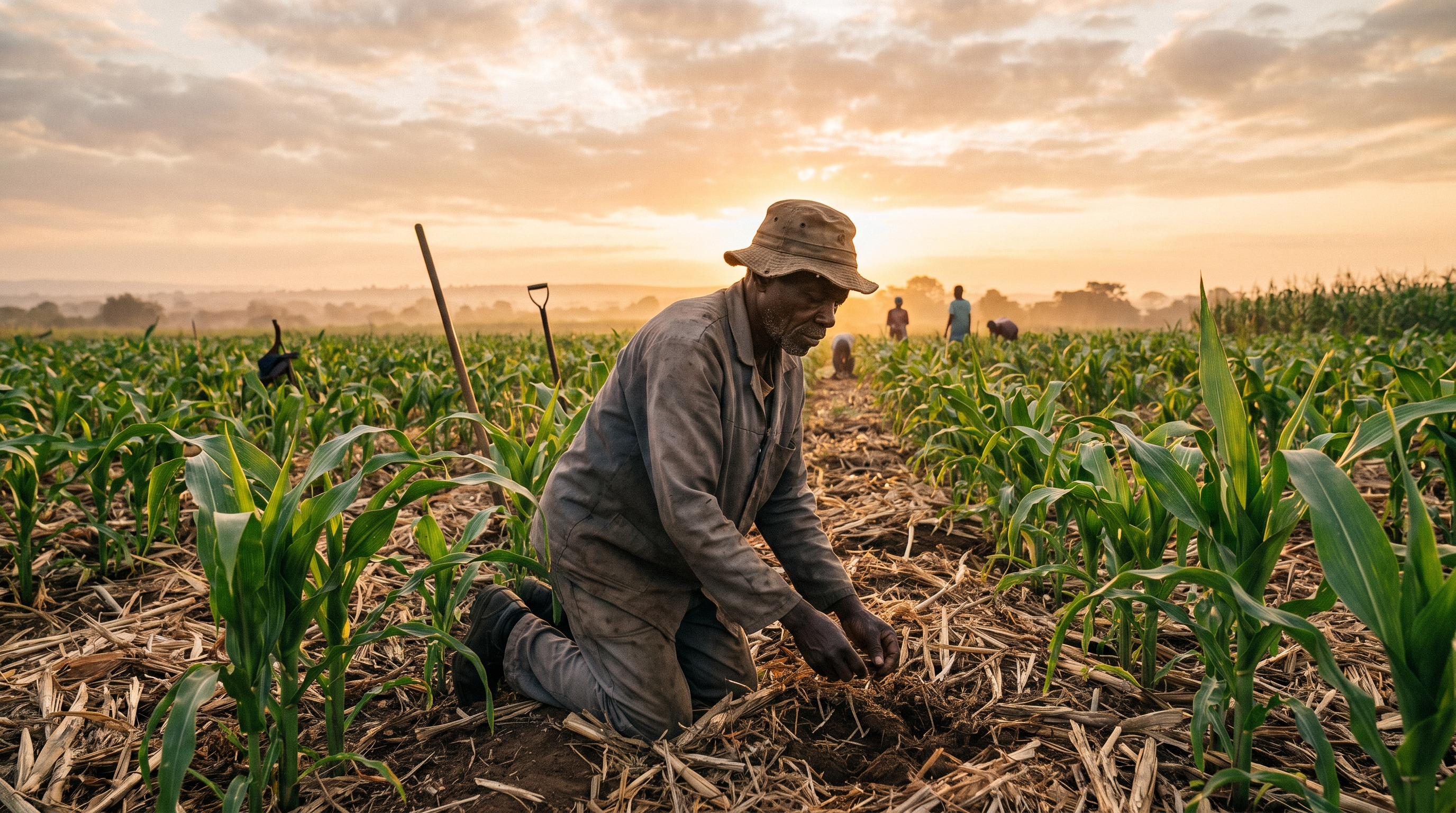
Farmers hear "conservation agriculture" pitched as a bundle — minimum tillage, permanent soil cover, crop rotation, done. The trial data from Zimbabwe tells a more specific story about where it pays off and by how much, and it doesn't always match the pitch.
What the long-run trials found
One of the largest datasets comes from 48 field experiments run across Zimbabwe between 2004 and 2010, comparing planting basins and mechanised ripper lines against conventional ploughing. On sandy soils — the kind that dominate Zimbabwe's smallholder sector — basins beat conventional tillage by a weighted average of 0.365 t/ha, and ripper lines by 0.184 t/ha, with basins outperforming conventional practice in about 59% of the trials. Under lower rainfall (320–500 mm), basins still added 0.151 t/ha over ripper's 0.110 t/ha, though the advantage narrowed as rainfall and clay content increased.
One result runs against the standard conservation agriculture pitch: adding mulch on top of basins or ripper lines cut their yield advantage sharply — by 44% for basins and 89% for ripper systems. That doesn't mean mulch is worthless everywhere; it likely reflects nitrogen tie-up as crop residue breaks down, or residue management problems specific to those trial sites. But it's a clear signal that stacking all three conservation agriculture principles at once isn't automatically the highest-yielding option on every field.
Farm-level case data backs up the basin result. One documented Zimbabwean smallholder using minimum-tillage basins, rotation and mulch moved from 1.5 t/ha to 2.5 t/ha of maize in the 2023/24 season — a jump large enough to change a household's food security position, even if it's not typical of every adopter. Across a broader comparison, maize under conservation agriculture management averaged 1.39 t/ha against 0.82 t/ha under conventional tillage, and in the driest districts the practice has been credited with yield gains of up to 50%.
Why adoption still lags the yield case
If the yield case is this solid, the obvious question is why conservation agriculture isn't universal in Zimbabwe. A 2025 nationwide survey covering 2,117 households and more than 10,000 cultivated plots found adoption tracks closely with exposure to climate shocks and poor soil fertility — farmers under the most pressure adopt fastest — but insecure land tenure and weak market access pull adoption back down. That matches what shows up informally on the ground: digging basins by hand is labour-intensive, and a farmer without secure tenure has less incentive to invest in a practice whose soil-building benefits take several seasons to show up.
The practical takeaway isn't "adopt everything at once." It's closer to this: basins outperform ripper lines on sandy soil, especially in drier zones; mulch needs to be managed deliberately rather than assumed to help by default; and the yield benefit compounds over multiple seasons rather than showing up fully in year one. Farmers on heavier, higher-rainfall soils should expect a smaller yield bump from tillage changes alone, and may get more return from the rotation and cover components of conservation agriculture than from basins specifically.
None of this argues against conservation agriculture — the multi-year trial data is unambiguous that it adds yield on the soils that dominate Zimbabwe's smallholder sector. It argues for treating "CA" as three separate decisions — tillage, cover, rotation — rather than one bundled package, and matching each to the specific field rather than applying all three uniformly.
Sources
- Regenerative & Conservation Agriculture Examples In Zimbabwe, Farmonaut
- Effect of Conservation Agriculture on Maize Yield in the Semi-Arid Areas of Zimbabwe, Experimental Agriculture (Cambridge Core)
- Conservation Agriculture and sustainability of smallholder farms in Zimbabwe: Insights from a nationwide survey, Land Use Policy (ScienceDirect)