
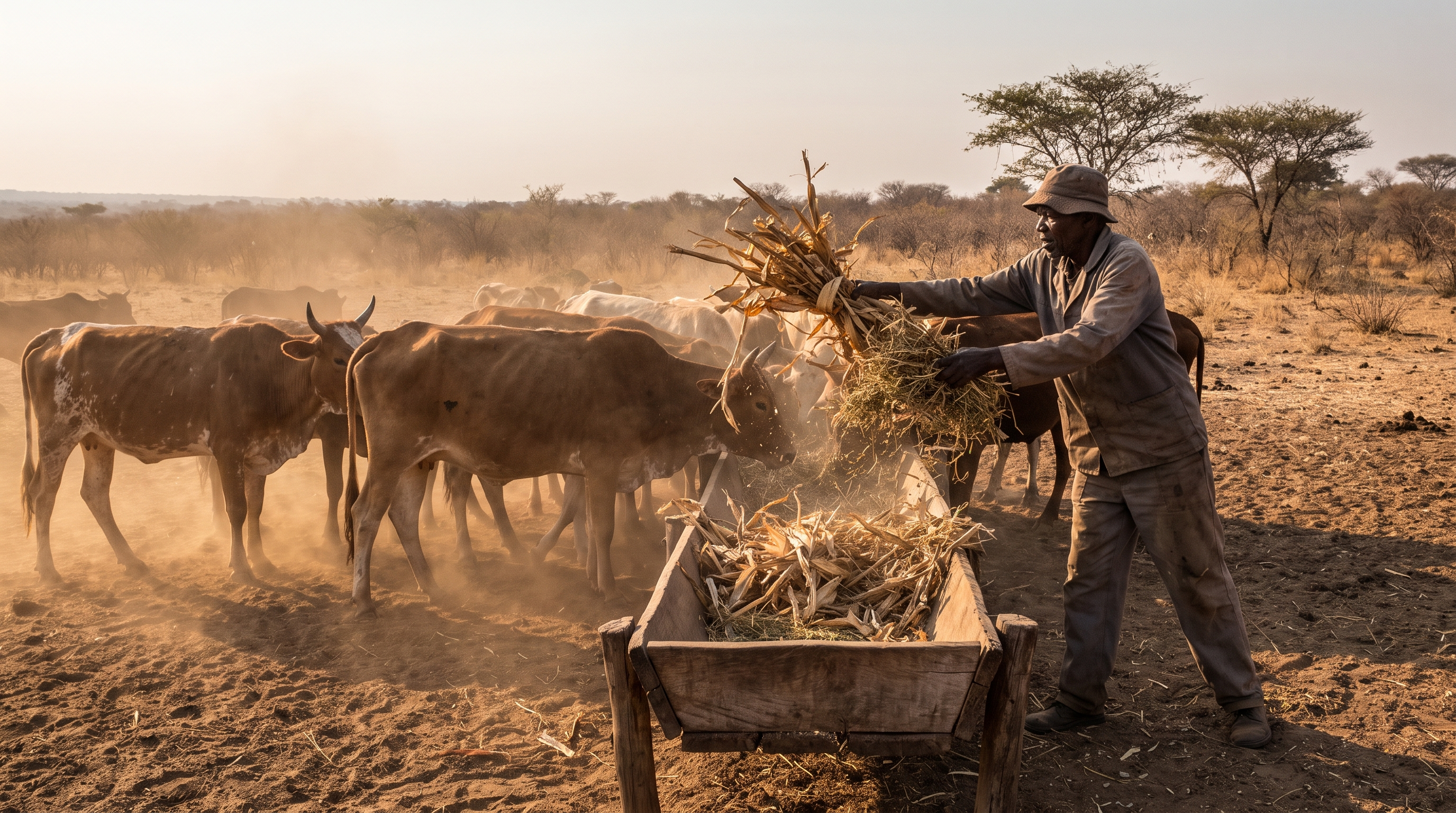
Zimbabwe's communal areas carry roughly 3.8 million cattle and 2.6 million goats, and cattle alone make up close to 89 percent of the grazing-animal biomass on that land. Most of that land is stocked at close to double its recommended carrying capacity. The result shows up every dry season: veld crude protein, which needs to sit around 7-8 percent just for maintenance, drops to as low as 2.5 percent by the time the grass has cured out. Cattle go into winter losing condition, and by September many are surviving on standing hay with almost nothing left in it.
This isn't a rainfall problem you can wait out. It's a feed-budget problem, and the farmers getting through it in reasonable shape are the ones treating it that way months in advance.
Why "just graze longer" stops working
The standard communal pattern is to graze animals in designated areas through the growing season and kraal them at night, then let them range freely over crop residues after harvest with little regulation. That free-for-all on residues is itself a waste — stover and stalks get trampled and fouled faster than they get eaten, and by August there's often little of nutritional value left standing. Supplementary feeding remains rare in these systems, mainly because cash is tight and, for many communal herds, the animals aren't run as a commercial enterprise in the first place — they're draught power and social capital more than a feedlot business. That's a real constraint, not a knowledge gap, and any feeding strategy has to work inside it.
Low-cost options that are already working here
Three approaches are actually being used on Zimbabwean smallholdings right now, not just recommended in a manual:
- Selective residue collection and storage. Rather than letting stover get trampled in the field, some farmers gather and store it before the free-grazing period starts, so it can be rationed out later in the dry season when nothing else is left.
- Urea treatment of stover. Treating maize stover or tough grass with urea raises its protein content and digestibility significantly — a technique the Feed the Future Zimbabwe Livestock Development Program has been promoting alongside shared equipment, including group-funded diesel chaff cutters that let a handful of dairy farmers chop stover and crush grain together rather than each buying their own.
- Low-cost molasses and cactus-based blends. The same program has worked with farmers to build feed formulas around molasses, prickly pear (cactus), and crop residues — drought-tolerant, locally available ingredients that don't require imported concentrate.
Forage legumes are changing the arithmetic
The more structural fix is growing your own dry-season protein instead of buying it in. ILRI-backed work with smallholder beef and goat producers in Murehwa Ward 11 and the Madziva/Shamva area has been promoting hay and grain from drought-tolerant forage legumes — velvet bean, lablab, forage cowpea, and dual-purpose groundnut varieties — grown and processed at ward level. These rations work out cheaper than bought oilseed byproducts, mainly because there's no transport cost eating the margin. In on-farm trials, mature cattle on the legume-based diet gained 0.5 to 1.0 kg a day; over a 60-day fattening period that's roughly 30 kg of net carcass gain, worth on the order of USD 135 in additional income per animal at prevailing prices.
What to actually do before the grass runs out
If you're running communal cattle, the sequence that matters is: collect and store crop residues before they're grazed to nothing, treat what you can with urea if you have access to it, and plant even a small plot of lablab or velvet bean this coming season so you have your own dry-season protein source instead of relying on browse alone. Where none of that is feasible, the fallback farmers have used since the 1991-92 and 1993-94 droughts still applies — cull and sell some stock early, or arrange lease grazing, rather than watching the whole herd lose condition together. None of these are new ideas. What separates herds that come through the dry season in working condition from those that don't is usually just whether the feed plan started before the veld ran out.
Sources
- Communal Area Livestock Management Systems in Zimbabwe, FAO
- Strategies for Dry Season Feeding of Animals in Central and Southern Africa, FAO
- How Low- and No-Cost Technologies are Saving Cattle in Zimbabwe, Feed the Future
- Forage-based livestock fattening rations gaining popularity with smallholder beef and goat producers in Zimbabwe, CGIAR