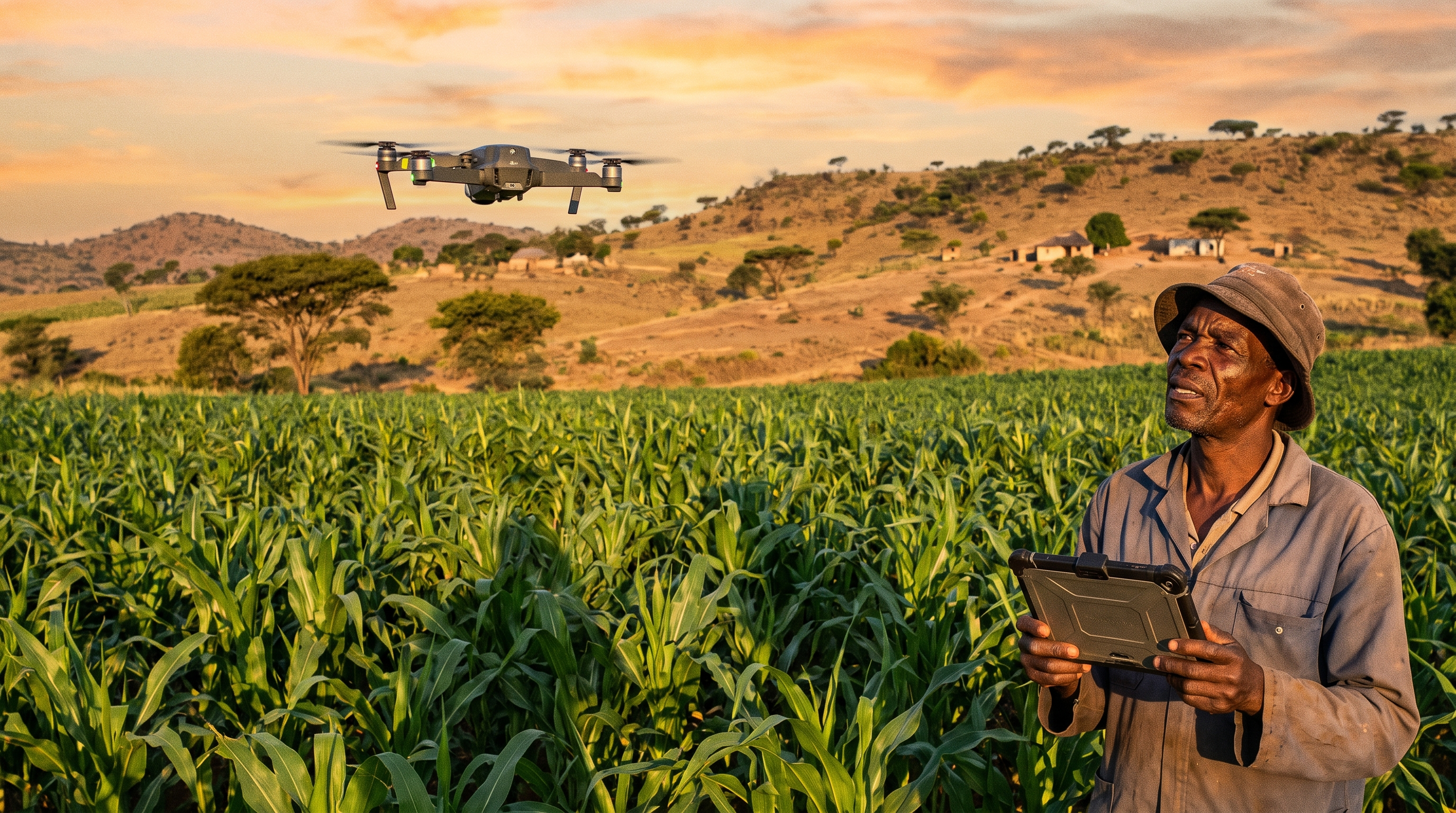
For most of the last decade, "drone agriculture" in Zimbabwe was a conference topic, not a farm-gate service. That's changed. Two homegrown operators — Talazo Agritech in Manicaland and Alley Capital Group, which assembles its own spraying drones locally — are now running real jobs on real fields, and the cost gap between locally built and imported drone systems is the single biggest factor in whether this technology pays for itself on a smaller farm.
Why the hardware origin matters more than the technology
The headline reason drone services have stayed out of reach for smaller operations isn't the concept — it's the price of the machine. Chinese-manufactured agricultural spraying drones imported into Zimbabwe run around $18,000, with replacement batteries at roughly $900 each. Alley Capital Group, founded in 2018 by two Zimbabwean aeronautical engineers, builds its own drones instead of importing them, bringing the unit cost under $4,000 with batteries around $375. That difference is what lets a service provider charge less than the roughly $18-per-hectare minimum that imported-drone operators need just to break even.
The knock-on effects show up in the actual spray job, not just the invoice. On lettuce and cabbage trials, drone spraying used 20 litres of solution per hectare against 75 litres with a tractor-mounted sprayer, with about 5% less pesticide applied while holding pest control steady. One farmer working with Alley Capital had been over-applying by roughly 120 litres of chemical per hectare a year before switching — a waste that shows up as input cost whether or not anyone is tracking it. There's a labour-safety angle too: workers spraying by hand or knapsack were previously exposed to chemical contact for up to four consecutive days per application cycle; a drone pass cuts that exposure window dramatically. Diesel savings matter as well — GPS-guided drone application replaces the 6-10 litres of diesel per hectare a tractor sprayer typically burns.
None of this is theoretical marketing copy. It's currently running on citrus, soybean and horticulture blocks in Zimbabwe, with the companies explicit that farmers are choosing it for productivity and input savings first, environmental benefits second.
Monitoring is a different service from spraying — and priced differently
Crop monitoring — flying a field to catch pest pressure, stress patterns or yield variation before they're visible from the ground — is a separate offering from spray application, and it's the newer of the two in Zimbabwe. Talazo Agritech, started by two computer science students after watching a 2023 pest outbreak hit Manicaland farms hard, combines drone imagery with AI analysis to flag problems early: pest detection, field-level crop monitoring, aerial surveys and yield analysis. The company doesn't publish per-hectare pricing, and at the time of writing it's serving farmers concentrated in and around Manicaland rather than nationally, so if you're farming outside that province, availability — not just cost — is the first thing to check before budgeting for it.
The regional case for this kind of tool is straightforward on paper: AUDA-NEPAD's African Union technology panel argues that drone-based field data collection gives smallholders a faster, more precise alternative to walking a field row by row for soil and crop condition surveys, which matters most on labour-constrained farms during peak season. Zimbabwe's own National AgriTech Strategy, launched in 2021, has pushed drone training into government agricultural extension programmes as part of a wider digitalisation push. The gap between that policy ambition and what's bookable on a phone call today is real — but it's closing, and it's closing through locally assembled hardware and homegrown startups, not imported systems.
What this means for a smaller farm right now
If you're weighing whether to bring drones onto a smaller Zimbabwean farm this season, the practical read is: spraying-as-a-service from a locally built fleet is the more mature, more affordably priced option today, and it's worth a call to compare a quoted per-hectare rate against your current diesel and chemical spend before committing. Monitoring-as-a-service is real but geographically limited and not yet transparently priced — treat it as worth inquiring about if you're in or near Manicaland, and worth watching for expansion if you're not. Buying your own drone outright, at $4,000-plus even for locally assembled units, only pencils out once you have enough hectares under management to spread that capital cost — for most operations under a few hundred hectares, hiring the service beats owning the machine.
Sources
- Zimbabwe Adapts to Use Technology in Agriculture, Connecting Africa
- Bolstering Africa's Precision Agriculture on Smallholder Farming, AUDA-NEPAD
- Drone-powered crop monitoring, built in Zimbabwe, Talazo Agritech
- Drone technology for cost-effective and environment friendlier farming in Zimbabwe, Africa Goes Digital