
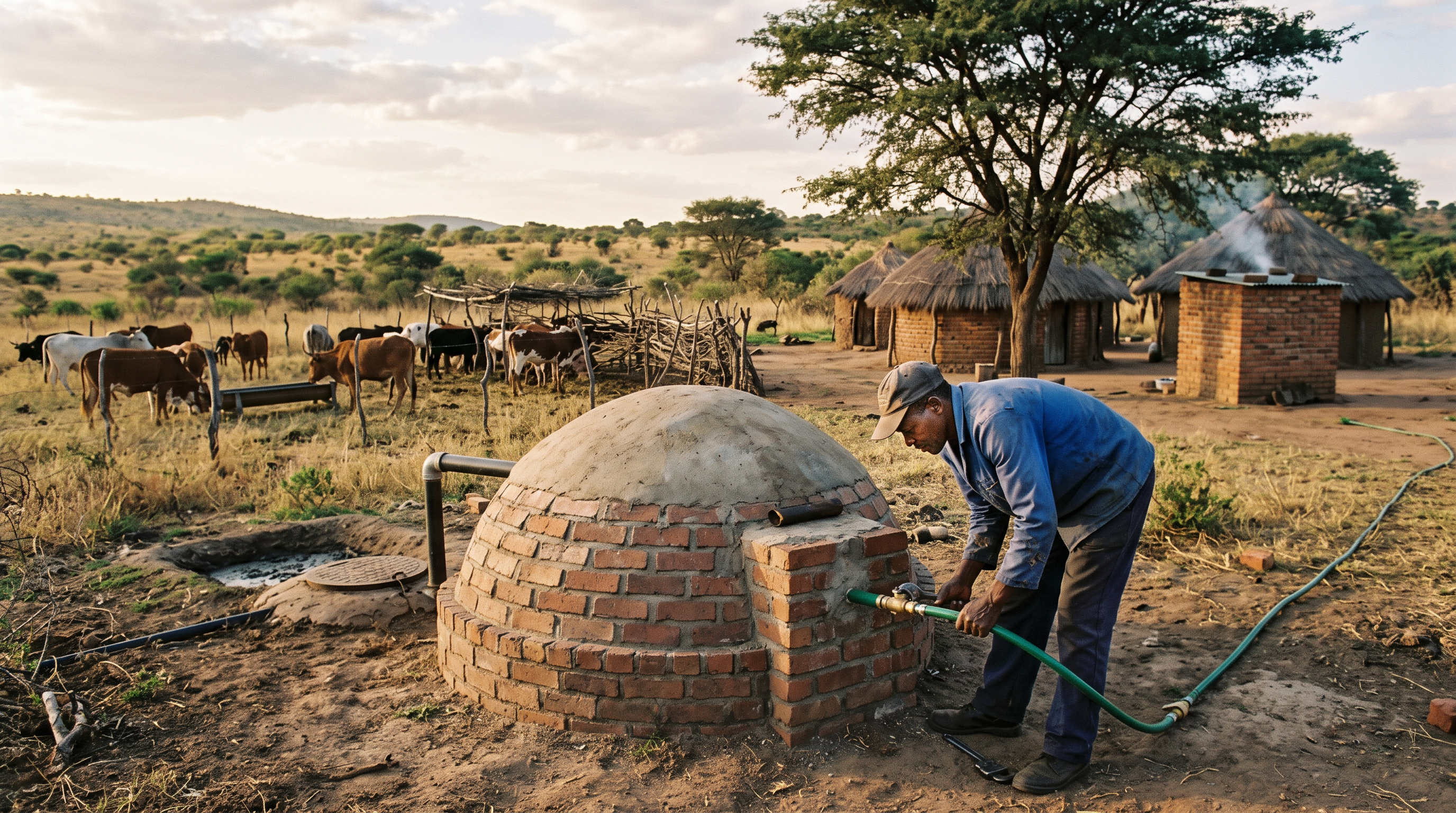
Zimbabwe loses an estimated 50 million trees a year to deforestation, much of it driven by firewood collection in rural areas without grid electricity. Biogas — gas generated by fermenting cattle dung (and other manure) in a sealed digester — is one of the few alternatives that uses something most homesteads with livestock already have lying around. It isn't free, though, and the two designs now in use in Zimbabwe sit at very different price points.
The standard fixed-dome digester
The version built through SNV and HIVOS's National Domestic Biogas programme — run with Zimbabwe's Ministry of Energy and Power Development, the Ministry of Agriculture, and the Renewable Energy Fund — is a fixed-dome design: an underground brick, cement and sand structure with an inlet chamber, a dome-shaped fermentation chamber, and a slurry outlet. The programme has built more than 150 of these across Insiza, Chegutu, Goromonzi and Mvuma districts, training over 70 masons and 18 fabricators to install and maintain them, and has reached over 1,385 rural households with the wider initiative.
Cost for an individual household unit typically runs US$600-800. A documented cooperative case — the Domboshava Community Development Association, a 30-member group — built 23 digesters with US$8,500 in funding from the US Embassy, backed by a monthly member contribution of US$15 per household. That's a meaningful sum in a rural household budget, and it's part of why uptake has stayed slow relative to the scale of the firewood problem: the programme's 150-plus digesters nationally are a fraction of the households that could use one.
What you get for the outlay is gas for cooking and lighting, plus a slurry byproduct that households are already using as organic fertiliser in place of purchased chemical fertiliser — one farmer in the programme described the switch as "making life easier and affordable." SNV's programme is also piloting appliances designed to run on the gas output, including fridges and geysers, though those aren't yet standard equipment.
A cheaper alternative built from scrap drums
Care International Zimbabwe's ECRIMS programme (Enhancing Community Resilience and Inclusive Market Systems, part of the Zimbabwe Resilience Building Fund) took a different approach: build the digester from metal drums instead of brick and concrete. The drums — often available free or cheap near mining operations — bring the cost down to roughly US$250, against US$800 for a standard brick household unit and US$2,000 for an institutional-scale one. By July 2020 the programme had installed drum digesters in 40 rural households across Zvishavane and Mbwerengwa districts in Midlands Province, with plans to expand to 200.
The tradeoff is capacity rather than durability of the concept: a single cow produces roughly 10 kilograms of dung a day, yielding about 400 litres of biogas, while cooking a single meal needs 150-300 litres per person. That math means a homestead with only one or two cattle will struggle to feed even a small family through a full day of cooking on biogas alone — the household needs several head of cattle producing dung consistently, not just access to a digester, for the system to actually replace firewood rather than supplement it.
What this means before you build one
Feedstock volume, not construction cost, is usually the real constraint. Before pricing a digester, count actual cattle numbers and household size, and estimate daily dung availability against the 400-litres-per-cow, 150-300-litres-per-person-per-meal ratio — a household short on livestock will be disappointed by either design regardless of price. Where mining-adjacent scrap drums are genuinely available, the Care International design cuts the entry cost by roughly two-thirds versus a standard brick unit, which matters for households that can't stretch to $600-800 plus a years-long member contribution. Where subsidised programmes through SNV, HIVOS or a district-level NGO are active in your area, that support is worth pursuing before self-funding a build, since it's what has made the brick-and-dome design viable for the households that have adopted it so far.
Sources
- National Domestic Biogas Programme — Zimbabwe, SNV
- Zimbabwe's rural dwellers turn to biogas for energy, SciDev.Net
- Zimbabwe is jump-starting rural biogas production with a new low-cost technology, D+C — Development and Cooperation
- Zimbabwe's National Domestic Biogas programme brings 150 biogas digesters, Bioenergy Insight Magazine