
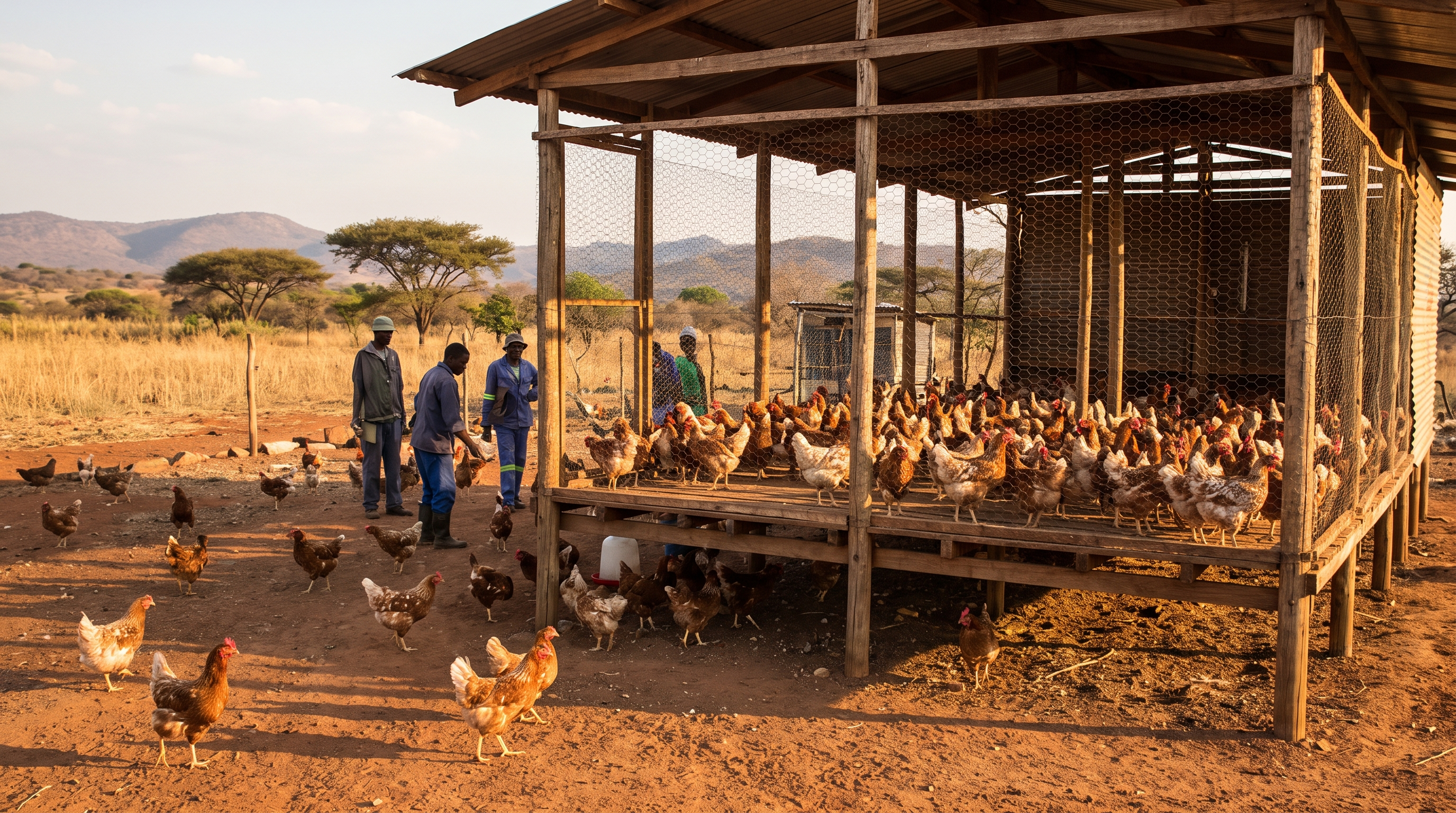
The costliest poultry housing mistakes in Zimbabwe aren't visible until the hot, still weeks before the rains — late September through October — when a shed that looked fine in July suddenly can't shed heat fast enough and birds start dying on the hottest afternoons. By then the building is finished and the fix is expensive. Getting siting and ventilation right at the design stage is cheaper than retrofitting fans and cooling pads later.
Siting comes before shed design
FAO's guidance on small-scale poultry production sets out the basics that get skipped when a shed just gets built wherever there's flat ground: pick a site that's easily accessible, has a reliable water supply, is well drained, and sits at a sensible distance from residential areas while still being close enough to secure and manage. Avoid siting near woodland or bush, which gives predators cover to approach the run under cover. None of this is exotic advice, but it's the difference between a shed you can service in the rainy season and one that turns into a mud trap every December.
Orientation is the part that gets missed even by people who nail the siting. In the tropics, FAO recommends running the long axis of the building east-west, which keeps direct sun off the long side walls through the middle of the day rather than letting it bake the full length of the shed as the sun tracks overhead. Painting roofing white or a light reflective colour matters more than it looks like it should — white paint reflects up to roughly 70% of incident solar heat radiation, according to the same guidance, which is a meaningful cut in the amount of heat the roof sheet is transferring into the shed air below it.
Why building width is the real ventilation lever
The single most consequential design number in a naturally ventilated poultry house is width, not length. FAO's poultry housing guidance for developing countries is specific on this: buildings wider than about 8m develop a significantly worse airflow problem, because the wider the structure, the more resistant it becomes to air moving all the way across it. A narrow shed with open or mesh-covered sidewalls lets prevailing wind pass clean through at bird level; a wide shed with the same sidewall openings ends up with dead air in the middle that no amount of roof ridge venting reliably fixes — the same source specifically notes that a centre-ridge vent doesn't solve this because it doesn't drive airflow across the full width of the shed.
Practically, this means: if you're planning a long house to hit a target bird count, extend the length rather than the width once you've settled on a width around 6–8m. Orient the sidewalls to catch the prevailing wind for cross-ventilation, keep openings at bird level rather than high up near the roofline, and don't wall off the interior with solid partitions that block airflow along the shed's length.
Stocking density and what it costs you if you ignore it
FAO's small-scale poultry guidance gives working stocking densities that double as a heat-load planning tool, because more birds per square metre means more metabolic heat to shed in the same airspace: roughly 3 birds/m² for layers, 4 birds/m² for dual-purpose birds, and 4–5 birds/m² for meat birds, with perch space allowances of 15–25cm per bird depending on type. These aren't just welfare numbers — a shed stocked to the upper end of these ranges needs the ventilation design to actually work, because there's no margin to absorb a still, hot afternoon the way an understocked shed can.
Roofing choice interacts with all of this. A roof pitch that's too shallow holds heat under the ridge; FAO's guidance describes roughly 42° as a reasonable compromise between material cost and roof support cost while still shedding heat and rain effectively. Thatch, where the labour and materials are available, insulates better against radiant heat than bare metal sheeting, but metal sheeting painted white and combined with a generous roof overhang for shade is the more practical choice for most builders sourcing standard hardware-store materials.
Sources
- Small-scale poultry production, FAO
- Poultry Housing and Management in Developing Countries, FAO
- Farm Structures in Tropical Climates, FAO — animal housing design manual