
Most smallholders default to whichever buyer is closest, then wonder why margins stay thin. The three main channels open to a small-scale Zimbabwean farmer — open-air markets like Mbare Musika, the Grain Marketing Board, and export contract farming — pay on completely different terms, accept different volumes, and demand different things from a producer. Matching the crop and scale you actually have to the right channel is worth more than any single pricing tip. It also helps that the underlying conditions are relatively stable this season: the EU Joint Research Centre's agricultural monitoring system did not flag Zimbabwe as a production hotspot as of its August 2026 assessment, meaning none of the three channels below are being distorted by an acute drought or supply shock right now — the differences between them come down to structure, not crisis.
Open markets: cash, competition, and currency
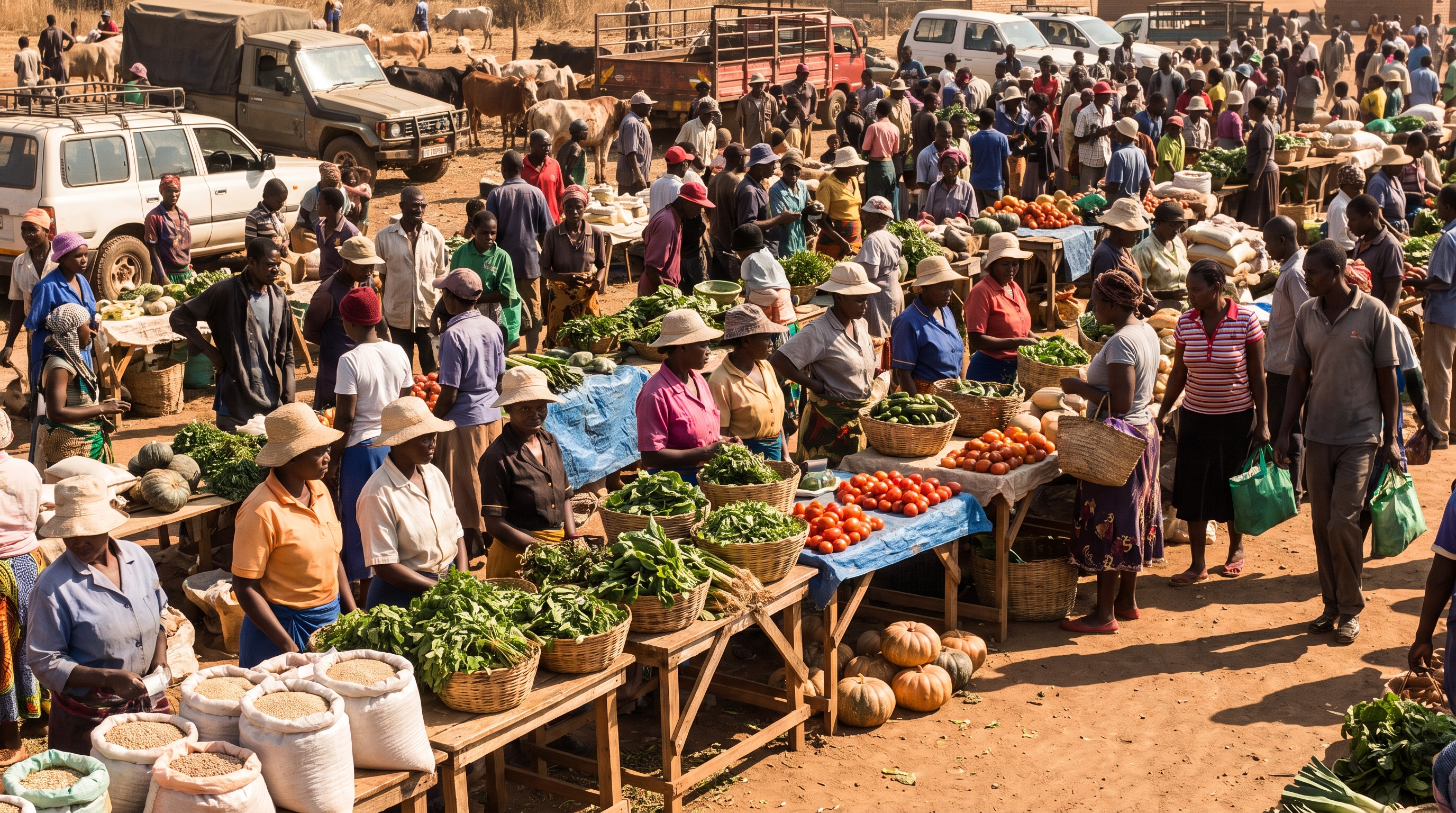
Mbare Musika in Harare remains the country's largest distribution point for fresh produce, and prices there move week to week on nothing more than supply and demand. A ground survey from early September 2026 put a 9kg box of tomatoes at US$5.00–US$7.00, a 15kg pocket of potatoes at US$8.00–US$10.00, and a large cabbage head at US$0.50–US$1.00 — wide ranges that the survey itself notes depend on trader, season, and volume sold. That spread is the real lesson: a tomato grower delivering into a supply glut can see the bottom of that box-price range, while the same crop sold when the market is short lands near the top — timing your delivery against the local supply cycle matters as much as the crop itself.
The other reality of open markets is currency. Traders at Mbare visibly prefer cash USD notes, accepting ZiG notes only when a buyer has no dollars on hand. If you're planning around ZiG pricing, expect friction converting it at the point of sale. This channel suits perishables in modest volumes where you need cash the same day and can absorb week-to-week price swings — it's a poor fit if you need contracted, predictable income.
The Grain Marketing Board: predictable, but capped
For maize and traditional grains, the GMB set its 2025/26 producer price at US$364.75 per tonne — down US$11.73 from the US$376.48 paid the previous season, the first cut of the incentive price since the board began paying in USD. The GMB positions itself as the buyer of last resort with 89 depots and 1,804 ward-based buying points, offering transport logistics, on-site grain swapping and access to inputs, and it markets itself as paying above informal market rates and on time.
The trade-off is that it's grain-only and price-capped by government policy rather than by demand — you know exactly what you'll get per tonne before you deliver, which is valuable for budgeting, but there's no upside if private buyers are paying more locally. It's the right channel if predictability and depot access matter more to you than chasing the top price, particularly if you're already growing maize for food security reasons under Pfumvudza.
Export contract farming: the highest ceiling, the highest bar
The biggest upside — and the steepest entry requirements — sits in export contract farming. Kuminda, a Harare-based aggregator, contracts roughly 5,000 smallholders to grow mangetout and sugar snap peas, securing EU export contracts first, then allocating hectares and supplying inputs and technical support before a single seed goes in. Zimbabwe supplies about 60% of the United Kingdom's sugar snap pea imports, and the country's horticulture exports reached US$181.7 million in 2025 — well above the previous 1999 peak of US$140 million.
This model only works if you can meet certification, grading and volume requirements, and it isn't immune to global shocks: Kuminda was paying US$3.80/kg in freight to reach European markets this year, up from US$2.00–US$2.20/kg last year, after fuel costs rose with the Iran conflict — a cost the aggregator absorbs but that ultimately shapes how much of a season's contracts get renewed or expanded. If you can get into a contracted scheme like this, the price ceiling is far above what Mbare or the GMB can offer, but you're taking on an aggregator's quality standards and exposure to freight and currency risk you don't control.
Matching channel to crop
None of these channels is universally "best" — they solve different problems. Perishable vegetables in small, irregular volumes belong at open markets where same-day cash matters. Grain intended partly for food security and partly for sale fits the GMB's predictable, capped pricing. High-value export crops like peas, where you can meet an aggregator's standards and commit hectares in advance, carry the highest ceiling but the least room for error. The mistake most smallholders make isn't choosing the wrong channel — it's using only one, when a mixed strategy across crops usually pays better than loyalty to whichever buyer is nearest.
Sources
- Fruit And Vegetable Prices — Mbare Musika, Zimpricecheck
- GMB Pegs Maize, Traditional Grains Prices At US$364.75 Per Tonne, The Zimbabwean
- Freight costs threaten Zimbabwe farmers' livelihoods as Iran war disrupts exports, The Zimbabwean
- Zimbabwe crop, livestock and market monitoring, EU JRC — ASAP