
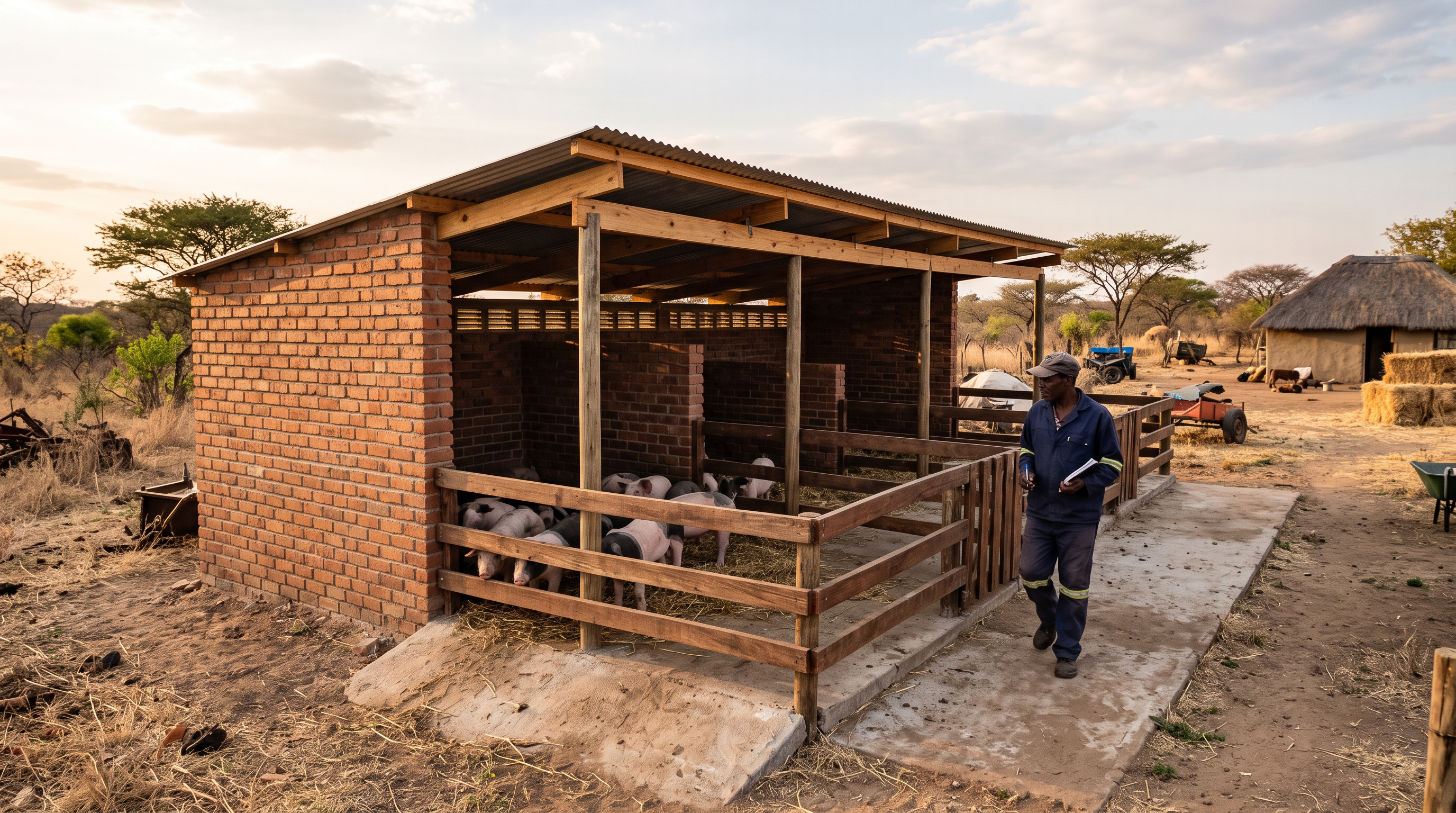
Most cost conversations around pig housing in Zimbabwe start and end with "bricks are cheap, we mould our own." That's true, and it's also the smallest line item on the job. The two builds worth learning from are both documented by Haven Agri-Construction: a 20m × 7m unit for 60 pigs in Mahusekwa, and a much larger 87m × 12m commercial unit for 1,000 pigs in Mazowe. Scaling from a backyard sty to a commercial one isn't just "more of the same pen" — the ratio of cheap materials (brick, sand, labour) to expensive ones (cement, roofing sheets, poles) shifts hard as the building gets longer.
Where the money actually goes
Brick is the one material most Zimbabwean pig farmers can produce or source locally at near-zero cash cost, which is why it dominates the wall area of both the Mahusekwa and Mazowe builds. Cement is a different story. A 50kg bag was trading around US$12 for most of 2024–25 and jumped to roughly US$17 by November 2025 — a 42% spike driven by a construction boom outstripping local production and importers running out of their Zambian import quota. For a pigsty, cement goes into the floor slab (non-negotiable — pigs on bare earth means parasites and impossible-to-clean floors), the foundation, and the mortar for brickwork, so that price swing lands directly on your budget regardless of size.
Roofing is the other real cost driver, and it's where farmers make the most consequential trade-off. At current Zimbabwe Building Materials Suppliers pricing, a galvanized IBR sheet in 0.40mm runs around US$5.00 per linear metre width, rising to roughly US$7.50 for 0.6mm gauge, while a 3.6m (12ft) galvanized IBR sheet is listed near US$9.00. Fibre-cement (asbestos-type) sheeting, still widely sold under the Turnall brand through outlets like Halsteds, is cheaper per sheet at the larger sizes — a 3.6m by 920mm sheet lists around US$27.50 — but it's heavier, meaning a beefier and pricier pole or truss frame underneath it. Treated gum poles for that frame range from roughly US$1 for a small 0.5m/25–50mm pole up to US$9–11 for a 1.2–1.5m heavy 150–200mm pole, so frame cost scales fast with span — which is exactly why the 87m Mazowe unit needed a properly engineered roof structure rather than a scaled-up backyard frame.
Sizing the pen to the pig, not the other way round
The Mahusekwa unit's 20m × 7m footprint for 60 pigs works out to roughly 2.3m² of covered floor per pig across the whole building — generous once you allow for passages, farrowing space and a dung channel, but it maps onto real husbandry numbers rather than guesswork. Individual sow pens are commonly built around 1.8m² per sow, while a boar needs a minimum of about 7m² of floor and a service pen of at least 9.3m² with no side shorter than 2.1m, according to housing guidance published by AgriOrbit. Growing and finishing pigs need less — commonly cited as 8–10 square feet (about 0.75–0.9m²) per growing pig and 12–14 square feet (roughly 1.1–1.3m²) per finisher, per guidance from The Pig Site — which is why a well-designed building splits into distinct pen types rather than one uniform shed.
Floor drainage matters as much as floor space. The same housing guidance stresses that floors should be cast with a fall toward the sides so urine runs to a shallow manure channel rather than pooling — something that has to be built into the slab from day one, because retrofitting a fall into an already-poured floor means breaking it out. Ventilation is the other non-negotiable: pens should stay cool and draught-free, with 22°C cited as a practical upper comfort threshold for breeding stock, which in Zimbabwe's hotter Lowveld districts pushes the design toward open sidewalls and generous roof overhang rather than a sealed shed.
What this means for budgeting
Before pricing a single brick, decide your capacity and pen mix (farrowing, dry sow, grower, finisher, boar), because that determines total floor area far more precisely than "how much land do I have." Then treat cement and roofing as the two line items to shop hardest on — a swing from asbestos-type to IBR sheeting, or a cement price spike like the one seen in late 2025, can move the total budget by a bigger percentage than doubling or halving the amount of brick you mould yourself.
Sources
- Pigsty Size: 20m by 7m, Capacity: 60 pigs, Location: Mahusekwa, Zimbabwe, Haven Agri-Construction Zimbabwe
- Cement prices jump 42pc amid burgeoning demand, Herald Online Zimbabwe
- IBR Roofing Sheets Prices, Galvanized and Asbestos Sheets Prices and Treated Poles Prices, Zimbabwe Building Materials Suppliers
- How to Farm Pigs: Housing, The Pig Site
- Housing requirements of pigs, AgriOrbit