
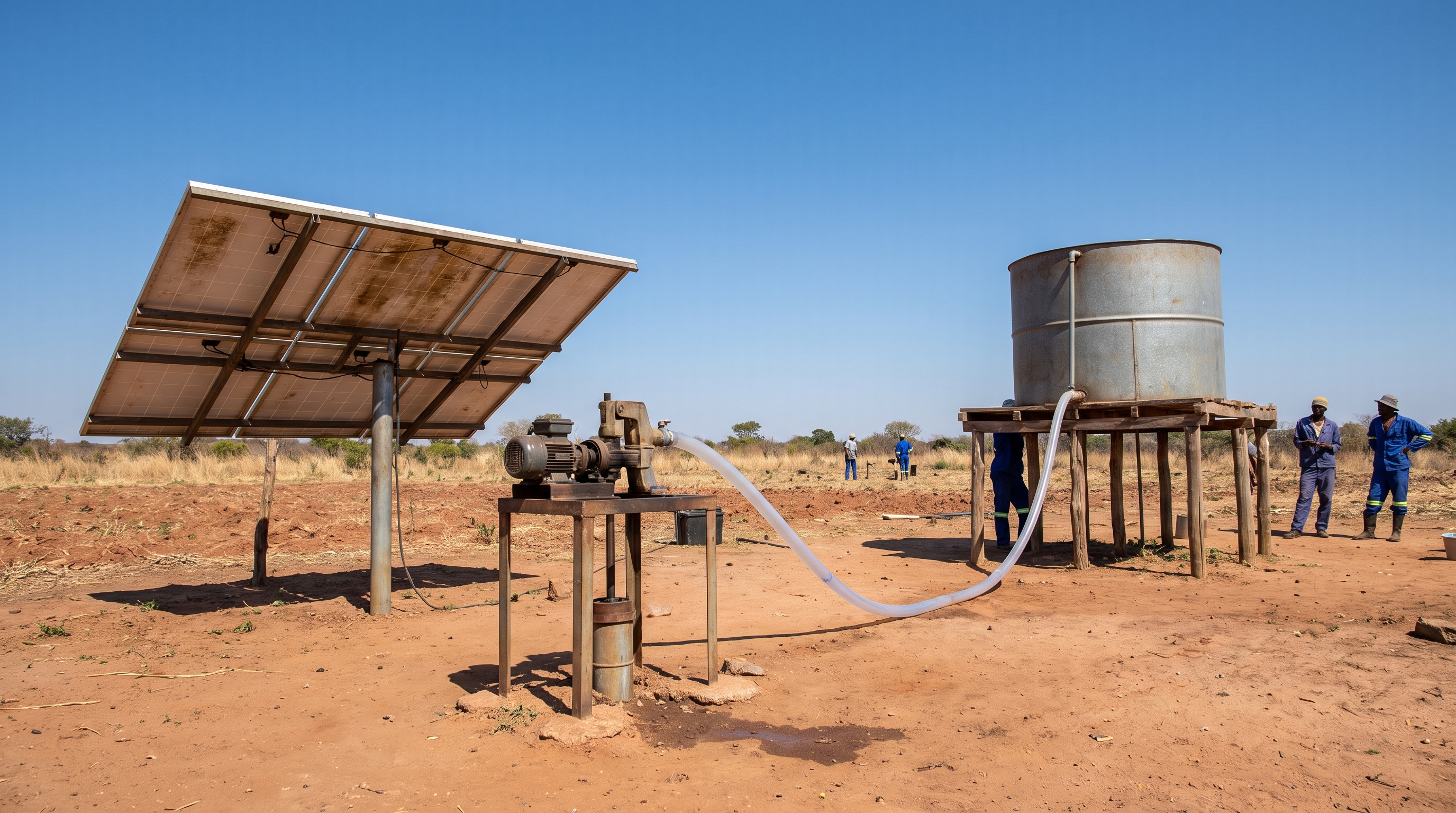
Lack of access to an irrigation pump is the single biggest limitation on productivity for smallholder farmers in Zimbabwe — cited by 75% of farmers surveyed for a 2025 IRENA assessment of the sector. The same survey found 75% of farmers also lack proper storage, with post-harvest losses reaching 50% in hot months. Solar pumping addresses only the first problem, but it's the one most farmers hit first: no reliable grid connection, no diesel budget for a generator, and a borehole that isn't earning its keep.
The pitch for solar is straightforward — no fuel bill, no dependence on ZESA's supply, which the utility has repeatedly promised to stabilise (most recently targeting an end to load shedding by December 2026) without a clean track record of hitting those targets. The catch is the upfront cost, and it scales fast with the size of the operation.
What the different tiers actually cost
At the small end, a 0.5HP solar water pumping system for a market garden or homestead plot runs from around US$1,800 fully installed, with panel-and-pump packages for boreholes typically priced between US$800 and US$1,500 depending on pump horsepower, and full borehole-plus-solar installation running US$750 to over US$2,300 depending on drilling depth. A complete 1-hectare solar pump kit — pump, panels, mainline and sprinkler or drip network — costs in the region of US$4,500.
Payback periods track farm scale rather than a flat percentage. One documented case of a 3HP system irrigating 4 hectares recouped its investment in an estimated 3-4 years; a smaller 1.5HP system running a poultry operation's water supply paid back in around 4 years. Below that scale — a single 0.5HP homestead pump — the payback period stretches out because there's less irrigated area generating income against the same fixed equipment cost.
Where the income gain actually shows up
The IRENA assessment found that after solar pumps were installed, household incomes rose 286% for very poor households, 173% for poor households, and 47% for middle-income households — a pattern that makes sense once you consider the baseline: a household with no prior irrigation capacity gets the largest relative jump from adding any pump at all, even before optimising it.
The clearest documented example at scale is Practical Action's REAP project in Gwanda district, Matabeleland South, funded by Sweden's international development agency (SIDA) at a total cost of US$2.4 million between 2017 and 2022. It installed solar-powered borehole pumps feeding storage tanks and drip networks across 33 communal gardens of roughly 20,000 square metres each, plus 7 larger drip-irrigation systems of around 200,000 square metres, reaching about 2,100 smallholder farmers in a region where rivers run dry every winter. Storage tanks were a deliberate design choice — solar pumps can't run on cloudy days, so the tanks bridge the gap and keep drip lines fed. IRENA puts the addressable market for solar-powered irrigation kits at roughly US$7.1 billion nationally if uptake reached the government's target of 2 million irrigated hectares, which gives a sense of how far current adoption sits below the ceiling.
The financing gap is the real bottleneck
None of this changes the fact that US$1,800 to US$4,500 is a lot of cash to raise before a single extra vegetable is sold. Zimbabwe's financial institutions remain reluctant to lend against smallholder agricultural assets, which is why the projects that have actually gotten solar pumps into the ground — Gwanda's REAP project among them — have run through donor-funded programmes rather than commercial finance. Farmers weighing the investment on their own should size the system to the plot, not the aspiration: a 0.5HP pump on a market garden earns back its cost far more slowly than a properly sized 3HP system on several irrigated hectares, and undersizing a kit to save money up front usually just moves the payback problem rather than solving it.
Sources
- Decentralised Renewable Energy for Agriculture in Zimbabwe (2025), IRENA
- Water for a parched land, D+C — Development and Cooperation
- Are Solar Powered Pumps Worth It in Zimbabwe?, Solar Energy Scout
- The 0.5HP Solar Water Pumping Systems in Zimbabwe (Price Catalogue), Sona Solar Zimbabwe
- 'No more electricity load shedding beyond 2026', says Zesa Group CEO, NewZimbabwe.com