
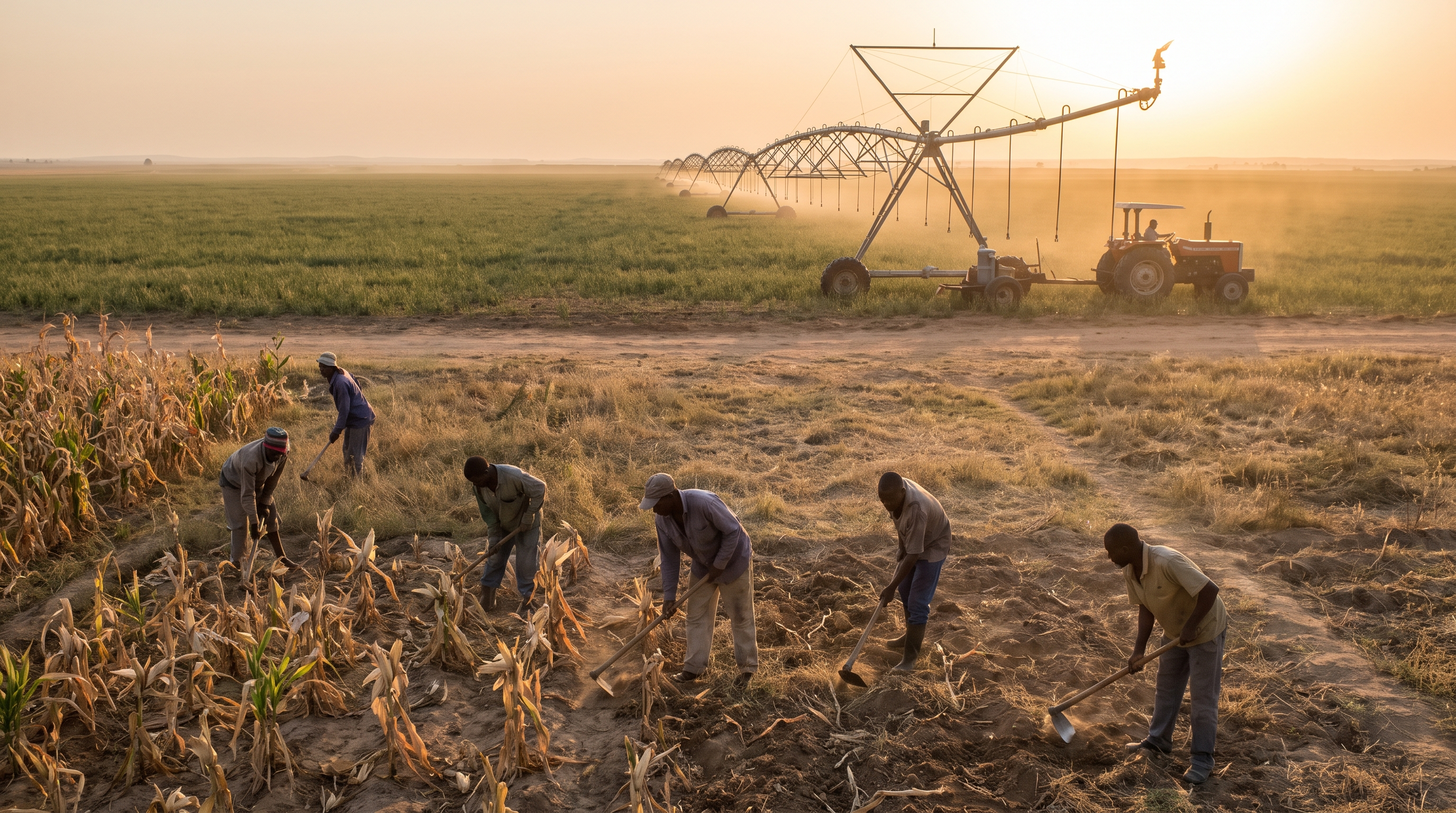
Zimbabwe has more than 50,000 medium-to-large-scale farmers, but only around 25,000 functional tractors between them, against an estimated need of 40,000 for commercial-level cultivation. That single statistic, from the US International Trade Administration's 2026 commercial guide to Zimbabwe's agricultural sector, explains more about the small-scale-versus-commercial divide than any discussion of farm size on its own. Access to mechanisation, finance and secure land title — not hectares farmed — is what actually separates a small-scale operation from a commercial one in Zimbabwe today.
The equipment and finance gap
The tractor shortfall matters because it compounds every other constraint. A farmer without reliable mechanisation plants later, weeds less thoroughly, and harvests slower — all of which show up directly in yield. The same ITA guide traces this pattern across crops: cotton output collapsed 96% over thirteen years, from 360,000 tons in 2011 to just 13,000 tons in 2024, with ginning capacity falling from 750,000 to 150,000 metric tons over the same period — a sector that shifted heavily toward contract farming precisely because independent smallholders couldn't carry the input and equipment costs alone. Soybeans tell a similar story from the demand side: national requirement runs around 240,000 metric tons a year, but local production covers only about 42,000 tons, roughly 18% of demand, even though farm-level returns on soy can reach up to 200% on investment — a gap that reflects a shortage of scale and inputs, not a shortage of profitability.
Underneath the equipment gap sits a finance gap, and that one is structural. Commercial banks have not extended loans against the 99-year leases that most A1 and A2 resettlement farmers hold, because those leases haven't been accepted as collateral. Government's land tenure reform, moving offer letters, permits and 99-year leases toward bankable, registrable and transferable title, was still mid-rollout as of August 2026 — around 27,045 plots surveyed and 10,231 mapped to beneficiaries nationally, with about 1,824 agreements of sale worth roughly US$110 million concluded. That's real progress, but a lease on its own still can't get a farmer a mortgage today. Until title is bankable at scale, farmers who'd otherwise borrow to buy a tractor or expand irrigation are locked out of the credit that would let them close the mechanisation gap themselves.
Where the numbers actually favor scale — and where they don't
It isn't a uniformly bad picture for smaller operations. Zimbabwe's 2025 wheat harvest reached about 560,000 tons against domestic consumption of roughly 360,000 tons — a surplus year — and corn production for 2024/25 came in around 1.3–1.8 million tons against a 2.0 million ton domestic requirement, with the 2026/27 season projected to recover further on favourable La Niña rainfall, according to the USDA's Foreign Agricultural Service. Government has also moved to protect local processors' demand for grain, requiring millers to source 40% of supply locally by April 2026, rising to 100% by April 2028, alongside a September 2025 ban on corn, grain and oilseed imports except during shortages — both of which push buying pressure back toward domestic producers, small-scale and commercial alike, rather than favouring one over the other.
Where scale still wins decisively is horticulture and other high-value export crops. M&J Consultants' 2026 investor guide singles out high-value horticulture as generating strong returns on the back of premium international pricing — but that opportunity assumes certification, cold-chain logistics and consistent volume, exactly the entry price a small-scale operation struggles to meet alone. It's precisely the category where aggregator-run contract schemes have emerged, letting smallholders access commercial-grade market access without owning commercial-grade infrastructure themselves. Zimbabwe's Economic Partnership Agreement with the EU gives duty-free, quota-free access for horticultural exports, and the country's fruit and vegetable market was estimated at US$1.91 billion in 2026, projected to reach US$2.41 billion by 2031. Capturing that growth without commercial-scale capital increasingly means going through an aggregator's contract rather than trying to build the cold-chain and export certification independently — the aggregator absorbs the capital cost of scale, and the smallholder supplies the labour and land.
What this means for planning your operation
The practical takeaway isn't that small-scale farming is a losing proposition — soy at up to 200% ROI and a horticulture market growing at nearly 5% a year say otherwise. It's that closing the yield and income gap with commercial operations right now depends on working around the tractor and finance shortages rather than waiting for them to resolve. Contract and aggregator schemes, government-backed input programmes, and crops with structural demand (like grain, now protected by the localisation mandate) offer paths to commercial-level returns that don't require owning a fleet of equipment or a bankable title yet. As land tenure reform matures and credit against it opens up, that calculus will shift — but for the current season, matching your crop choice to a channel that supplies capital, inputs or market access on your behalf is the more reliable lever than scaling land alone.
Sources
- Zimbabwe Country Commercial Guide: Agricultural Sectors, US International Trade Administration (2026)
- Zimbabwe: Grain and Feed Annual (2026), USDA Foreign Agricultural Service
- Zimbabwe Investor's Guide 2026: Commercial Agriculture Opportunities, M&J Consultants
- Land Title Deed Programme Unlocks US$110 Million So Far: Tagwirei, ZimEye
- Zimbabwe Fruits and Vegetables Market, Mordor Intelligence